
Mobile Engineer Career Path: Rising with a Growth Mindset
06/02/2026

62
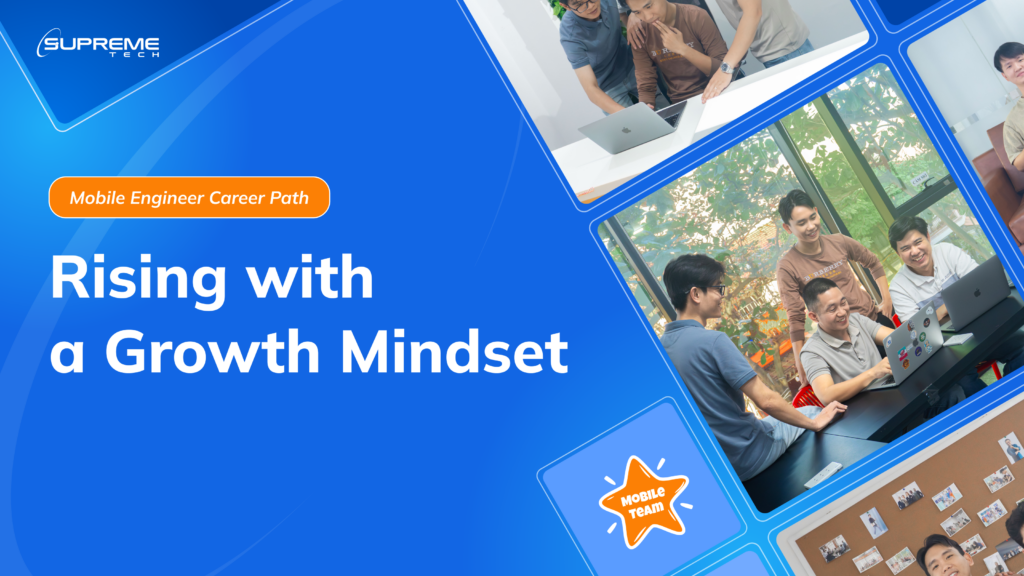
The career of a Mobile Engineer involves much more than just writing Clean Code or chasing the latest frameworks. It is a continuous journey of transforming one’s mindset to expand influence and create core value for the product.
This article outlines the Mobile Engineer career roadmap at SupremeTech and dives deep into the four core mindset factors. These are the keys to helping you break through from a task executor to a Strategic Leader.
I. Career Roadmap: From “Coder” to Architect or Leader
A career advancement path is defined not just by years of experience, but by the expansion of one’s Scope of Impact and leadership role.
- Junior Mobile Engineer: You focus on mastering the basics, completing assigned tasks, and learning from mentors. Your primary goal is to deliver stable features within the mobile ecosystem.
- Middle Mobile Engineer: At this level, you begin to take ownership of complex features. You proactively optimize performance and contribute to the technical decision making process for the application.
- Senior Mobile Engineer: Your impact reaches beyond code. You mentor others, design scalable architectures, and ensure that the mobile product aligns with business objectives.
- Tech Lead or Architect: You become a strategic visionary. You solve high level technical challenges and guide the entire team toward long term innovation and efficiency.
| Career Level | Scope of Responsibility | Scope of Responsibility |
| 1. Associate Software Engineer | Mastering fundamental foundations such as Syntax, Git Flow, Unit Test. | Focusing on the successful completion of assigned tasks. |
| 2. Software Engineer | Demonstrating autonomy by applying standard architectures like MVVM and Clean Arch. | Taking full ownership of end to end Feature development. |
| 3. Senior Software Engineer | Designing complex modules, performing high level performance optimization, and providing technical mentorship. | Leading a specific Team or Module while managing large scale technical segments. |
| 4. The Career Fork | Pursuing professional specialization through either Deep Technical Expertise or People Management. | Driving impact at the System or Organizational level. |
📌 Deep Dive into “The Fork”
After reaching the Senior level, you will face a crucial decision: continue conquering technical heights or transition into people management?
- 🛠 4A. Technical Leader (TL): An architecture expert who shapes the Tech Strategy.
- 🤝 4B. Associate Engineering Manager (AEM): Manages team performance and fosters People Growth.
Note: The company is always ready to accompany and advise you so that you can choose the career path that best fits your passion and strengths.

II. Four Mindset Factors Shaping Your Advancement
Why do some people with the same years of experience promote faster while others stay in place? The secret lies in a Growth Mindset. Here is how this mindset transforms into action at each level:
1. Product Thinking 🧠
It is not just about coding a feature, but solving problems for users.
- Associate/SE: Understand who this feature serves and what problem it solves.
- Senior SE: Challenge requirements. Propose better solutions regarding UX or technical feasibility.
- TL / AEM: Shape the product strategy from a technical perspective (TL) or allocate resources to achieve project goals (AEM).
2. Solution Trade-offs ⚖️
There are no perfect solutions, only the most suitable ones.
- Associate/SE: Identify technical options and list basic pros and cons.
- Senior SE: Make trade-off decisions (for example: Release Speed vs. Code Quality) and clearly explain the reasoning to stakeholders.
- TL / AEM: Ensure trade-off decisions are optimal for long term company goals such as Scalability or Delivery.
Common Trade-offs:
- Speed vs. Quality/Stability: Should we use a quick, temporary solution for faster Time to market and accept Technical Debt?
- Flexibility vs. Simplicity: Should we build a complex architecture for future changes or keep it simple for current needs?
- Reusability vs. Performance Optimization: Sometimes, a highly reusable solution can be less efficient than a solution written specifically for a unique case.
3. Mentoring 🌱
Grow stronger by helping others grow.
- Associate/SE: Actively seek feedback and share small tips or tricks learned.
- Senior SE: Lead Juniors. Share efficient workflows. Perform educational Code Reviews by explaining the “why” instead of just finding bugs.
- TL / AEM: Multiply impact. Build a learning culture (AEM) or communicate a deep technical vision (TL).
4. Ownership 🔥
An attitude of taking charge of the game.
- Associate/SE: Complete tasks with high quality including self testing and low bug counts, following through until code reaches Production.
- Senior SE: Own a major Module. Proactively identify and solve cross team issues.
- TL / AEM: Hold full Accountability for the success or failure of the system (TL) or the entire team (AEM).
III. Conclusion: Activating Your Growth Mindset
A Mobile Developer career is a marathon, not a sprint. To break through to the Senior level and beyond into leadership roles, start changing your habits today:
- When coding: Always ask “What is the value for the user?”
- When designing: Always consider “What are the gains and losses?” (Trade-offs).
- When communicating: Do not just pass information; create value and help your teammates.
- When working: Commit to the final result, whether good or bad.
🚀 Where are you on this journey and what is your next goal? Please share with us!